Language Learning AI
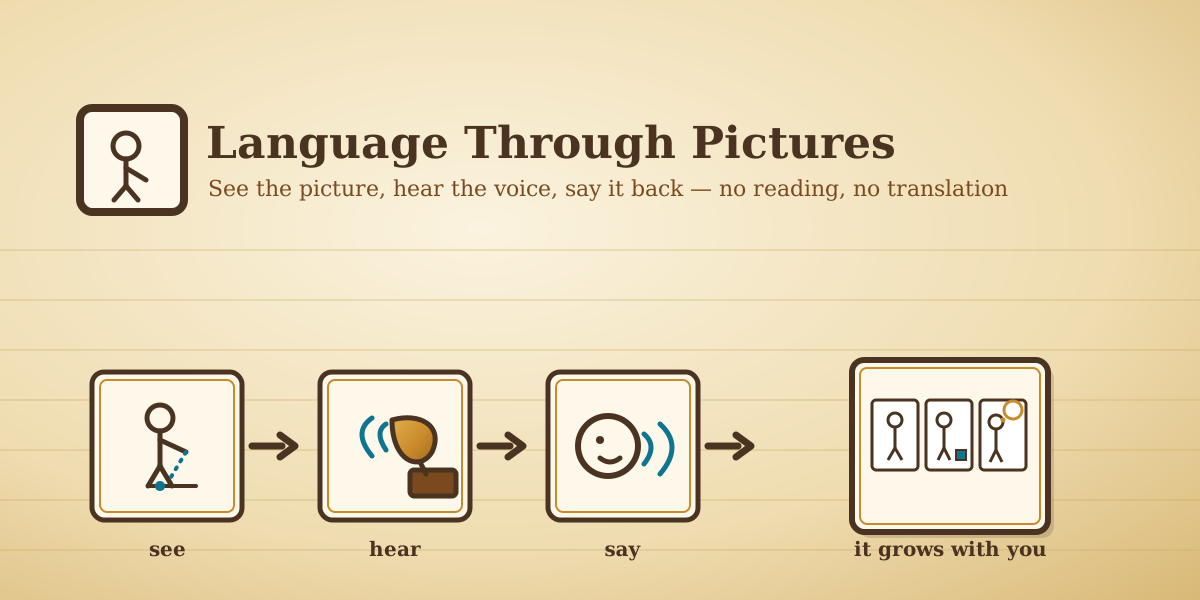
Most language apps assume you can read and lean on translation into your first language — locking out the people who most need access: non-readers and learners whose language uses a different script. Decades earlier, the Graded Direct Method (I.A. Richards and Christine Gibson's English Through Pictures) taught a spoken foundation with no translation and no alphabet, using simple pictures that change one step at a time alongside the sentence, from concrete situations to abstract ideas. It never scaled because every picture was hand-drawn and every lesson teacher-led. This research rebuilds that method with AI as a see-hear-say tutor: the learner sees a generated stick-figure panel, hears a native voice say the sentence, and repeats it aloud, with speech recognition closing the loop — and it ships offline for learners with little connectivity.
This thread rebuilds the Graded Direct Method (GDM) — a proven, pre-digital way to teach a spoken foundation with no translation and no alphabet — as an AI-native, literacy-free see-hear-say system. Faithful to GDM, each step introduces one new element and moves from concrete situations to abstract ideas, with meaning carried by picture and voice rather than translation. The problem it takes on is scaling that method without a human illustrator or teacher: the picture panels are generated automatically and automatically checked for faithfulness to the intended step, a native voice speaks each sentence, and the learner's spoken repetition closes the loop. It is built product-grade like the lab's teaching-assistant work — durable, versioned, auditable content — authored and verified centrally, then shipped as a self-contained offline bundle so the whole loop runs on low-cost hardware without connectivity. Framed around the learners mainstream apps exclude, its evaluation centers on non-readers and low-literacy users. It reuses only the uncopyrightable pedagogy and Basic English vocabulary, shipping its own generated art. It draws on vision-language models, text-to-speech, on-device speech recognition, and spaced-repetition learning. Faculty-advised.