

We need experience to get a job. We need a job to get experience. Let's break that loop.

So "years of experience" doesn't start at zero.

We build production AI systems for communities that need them most.

If you want hands-on engineering tied to partner needs, there is room to contribute here.

From student to engineer. For real.

Faculty & Advisors

Prof. Eugene Pinsky, PhD

Prof. Eugene Pinsky, PhD

BU · Harvard · Columbia

Research rigor means being able to show your work at every step — the methods, the assumptions, the limitations...
Prof. Kathleen Park, PhD

Prof. Kathleen Park, PhD

Harvard · MIT · BU

Most agentic AI research focuses on what these systems can do. We at AnacodicAI Labs focus on who they're for...

Who we are, and why we build

Why we exist

Some communities have a clear need for technology and no path to it. Not because the problem is unsolvable, but because no one is paid to solve it for them.

We build in that gap: students gain real-world experience on real data, held to a peer-reviewed evidence bar.

Foundations & Methods

METHOD TRACK

The rigorous, publishable method and capability work behind the mission — new statistics, ML/representation methods, reasoning and multi-agent capability studies, and systems benchmarks. Not a humanitarian claim on its own; it's where students earn Q1 authorship with faculty.

How we bridge it

You bring the skills; they hold the mandate. We run the collaboration like research and ship like production. Clear scope, honest review, systems held to a production bar, not a demo bar.

What you get

Students gain production commits, published research, and documented contributions. See:

  • Production experience led by engineers actively working in industry
  • Research publications with R1 faculty
  • Recommendations Letters or References

Where we build

Rooted at Boston University.

Built for where infrastructure, capital, and specialist access run out first.

MEMBER STORIES

Proof that end-to-end work on real systems for real stakeholders changes trajectories.

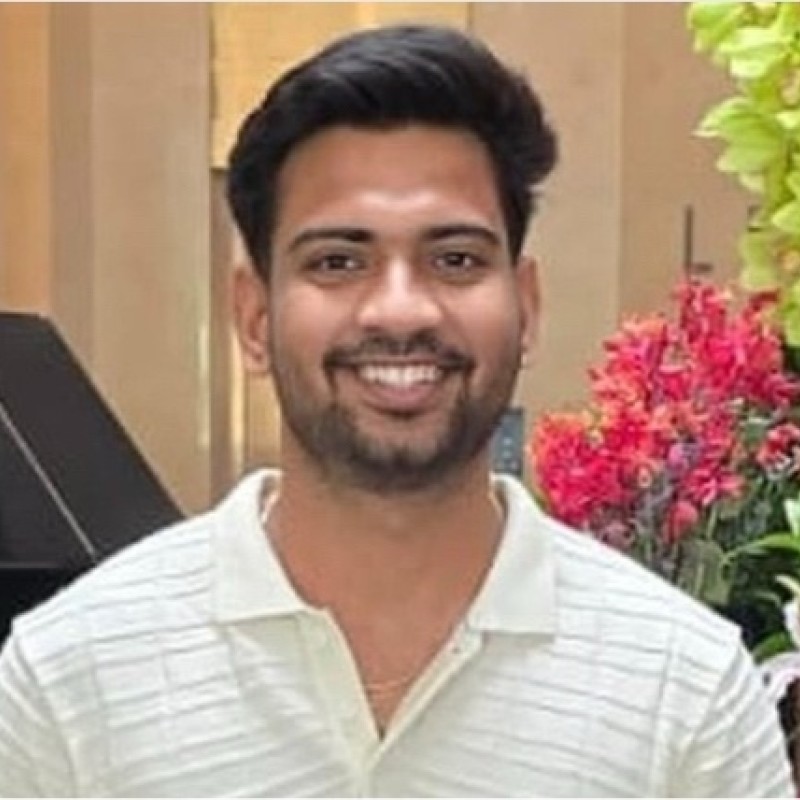
Dishant Pandauria

Backend engineer by day — shipping agent systems on the side

I joined to help the team ship, not to switch careers. Co-leading delivery on SafeBite and TerrierTA forced agent design and evaluation into my day-to-day — the kind of constraints that changed how I think about failure modes and observability in production pipelines — skills I use when I build telemetry pipelines at New Relic.

Before

Backend SDE building distributed systems in Go, Kafka, and AWS

At the lab

Delivery across SafeBite, TerrierTA, and cost-constrained agent systems

After

SDE @ New Relic — stronger on production patterns for AI-adjacent systems

Bhanu Sharma

From data engineer to AI research — with papers to show for it

I came in as a data engineer and ended up co-authoring research — SafeBite and the lab's AI-sustainability work, plus my own first-author paper. Doing it end-to-end, with faculty mentorship, is what opened the AI Research Engineer role at Dell.

Before

Data engineer at UnitedHealth Group (Optum)

At the lab

SafeBite + sustainability / supply-chain research; co-author on lab papers

After

AI Research Engineer at Dell — still publishing while employed

Varanjot Singh

HR systems specialist — learning research-grade AI without changing careers

My day job isn't AI research. I joined because the team needed someone who could test, document, and ship — and I wanted to learn what people are actually building this year, not from a two-year-old course. The evaluation work on TerrierTA and co-authoring Knowledge-in-a-Box gave me skills I use when HR products talk about AI.

Before

HR systems and enterprise software (Eightfold, Darwinbox); BTech Mechanical

At the lab

TerrierTA evaluation methodology; Knowledge-in-a-Box co-author; manuscript translation and provenance research

After

Specialist HR Systems @ Amgen — same career path, stronger on how AI systems are built and evaluated

Rajat Yadav

TerrierTA lead — full-stack from database to dashboard

TerrierTA is mine to run — PostgreSQL to React — and the first product I've taken from schema to shipped grading pipeline.

Before

Backend and DevOps engineer (Phenom, then observability tooling at New Relic)

At the lab

Lead, TerrierTA — full-stack frontend, PostgreSQL schema and data fixes, grading pipeline delivery; lab AWS and CI/CD

After

Software Developer @ New Relic — full-stack product lead for a live AI grading system (database to dashboard)

Vasudev Parmar

SDE II building platforms — first agent product, API to production

I build enterprise platforms for a living — Kafka, Kubernetes, developer portals. Potluck was the first time I owned an agent product end to end: the API, the agent backend, deployment, all the way to production. That kind of full ownership is the part you rarely get handed at a big company, and it's exactly why I joined.

Before

SDE building cloud-native enterprise platforms (Kafka, Kubernetes, developer portals)

At the lab

Potluck — designed and shipped the agent backend end to end, API to production

After

SDE II @ Phenom — platform engineer who's now built an agent product end to end

Dishant Pandauria

Backend engineer by day — shipping agent systems on the side

I joined to help the team ship, not to switch careers. Co-leading delivery on SafeBite and TerrierTA forced agent design and evaluation into my day-to-day — the kind of constraints that changed how I think about failure modes and observability in production pipelines — skills I use when I build telemetry pipelines at New Relic.

Before

Backend SDE building distributed systems in Go, Kafka, and AWS

At the lab

Delivery across SafeBite, TerrierTA, and cost-constrained agent systems

After

SDE @ New Relic — stronger on production patterns for AI-adjacent systems

Bhanu Sharma

From data engineer to AI research — with papers to show for it

I came in as a data engineer and ended up co-authoring research — SafeBite and the lab's AI-sustainability work, plus my own first-author paper. Doing it end-to-end, with faculty mentorship, is what opened the AI Research Engineer role at Dell.

Before

Data engineer at UnitedHealth Group (Optum)

At the lab

SafeBite + sustainability / supply-chain research; co-author on lab papers

After

AI Research Engineer at Dell — still publishing while employed

Varanjot Singh

HR systems specialist — learning research-grade AI without changing careers

My day job isn't AI research. I joined because the team needed someone who could test, document, and ship — and I wanted to learn what people are actually building this year, not from a two-year-old course. The evaluation work on TerrierTA and co-authoring Knowledge-in-a-Box gave me skills I use when HR products talk about AI.

Before

HR systems and enterprise software (Eightfold, Darwinbox); BTech Mechanical

At the lab

TerrierTA evaluation methodology; Knowledge-in-a-Box co-author; manuscript translation and provenance research

After

Specialist HR Systems @ Amgen — same career path, stronger on how AI systems are built and evaluated

Rajat Yadav

TerrierTA lead — full-stack from database to dashboard

TerrierTA is mine to run — PostgreSQL to React — and the first product I've taken from schema to shipped grading pipeline.

Before

Backend and DevOps engineer (Phenom, then observability tooling at New Relic)

At the lab

Lead, TerrierTA — full-stack frontend, PostgreSQL schema and data fixes, grading pipeline delivery; lab AWS and CI/CD

After

Software Developer @ New Relic — full-stack product lead for a live AI grading system (database to dashboard)

Vasudev Parmar

SDE II building platforms — first agent product, API to production

I build enterprise platforms for a living — Kafka, Kubernetes, developer portals. Potluck was the first time I owned an agent product end to end: the API, the agent backend, deployment, all the way to production. That kind of full ownership is the part you rarely get handed at a big company, and it's exactly why I joined.

Before

SDE building cloud-native enterprise platforms (Kafka, Kubernetes, developer portals)

At the lab

Potluck — designed and shipped the agent backend end to end, API to production

After

SDE II @ Phenom — platform engineer who's now built an agent product end to end

FEATURED RESEARCH

Open research threads · What we're researching right now

Safety-Critical Recommendation: Allergen and Dietary Safety in Conversational Food Systems

Safety-Critical Recommendation: Allergen and Dietary Safety in Conversational Food Systems

Safety-Critical Recommendation AI

Recommendation systems optimize for what a user will prefer — but when a wrong suggestion can cause real harm, such as recommending a dish containing an allergen to someone who must avoid it, preference and safety become competing objectives inside one model. This research examines how safety should be enforced in recommendation systems when the cost of an error is high.

Multi-AgentAI SafetyAllergen SafetyConversational RecommendationLLMProvenance

Rolling basis

Explore Research →
Carbon-Aware Inference Under Deployment Constraints: Extending the CCI Framework

Carbon-Aware Inference Under Deployment Constraints: Extending the CCI Framework

AI Energy Research

Extension of the published CCI energy benchmarking framework to deployment environments with infrastructure constraints. Energy cost characterization and carbon-aware model selection studied under constrained deployment conditions.

EnergyCarbon-Aware ComputeLLMDeployment ConstraintsSustainabilityAI Efficiency

Rolling basis

Explore Research →
Knowledge-in-a-Box: Offline Course-Grounded AI for Low-Connectivity, Cost-Constrained Classrooms

Knowledge-in-a-Box: Offline Course-Grounded AI for Low-Connectivity, Cost-Constrained Classrooms

Education & Access AI

Knowledge access should not depend on connectivity, yet most course-grounded AI assumes a reliable network and an ongoing cloud budget that constrained classrooms cannot sustain. This research investigates whether course-grounded assessment, tutoring, and content generation can run entirely offline on low-cost hardware while approaching the quality of expensive cloud models — turning intermittent connectivity from a barrier into a non-issue.

Offline-FirstEdge / On-Device InferenceEducation AccessLocal LLMCurriculum-GroundedGlobal South Education

Rolling basis

Explore Research →
Toward Carbon-Neutral AI Inference: Pathways, Metrics, and Honest Accounting for Net-Zero Large-Model Serving

Toward Carbon-Neutral AI Inference: Pathways, Metrics, and Honest Accounting for Net-Zero Large-Model Serving

Sustainable AI Research

AI inference has become a large, fast-growing source of electricity demand and carbon emissions — and unlike one-time training, it recurs on every query and scales with adoption, so AI's footprint is increasingly dominated by serving. Measurement now exists, but it does not tell us how to reach carbon neutrality or what "neutral" should honestly mean. This review organizes the problem around a single identity — per-query carbon = per-query energy × grid carbon intensity, scaled by query volume — and classifies the pathways to net-zero by the factor each one attacks, defines carbon-neutral inference as a credible residual-offset condition, and maps the accuracy, latency, and rebound costs of getting there.

Carbon NeutralityAI InferenceEnergy EfficiencyCarbon-Aware ComputingSustainable AINet-Zero

Rolling basis

Explore Research →

FEATURED PROJECTS

What we're building right now

SafeBite

Recommendation AI

Recommending food is easy — until a wrong suggestion triggers an allergic reaction. A conversational recommendation system that treats safety as a separate, non-negotiable check: a reasoning-and-acting (ReAct) orchestrator drives a 4-stage recommender — learned two-tower retrieval, a learned ranker, sequential modeling, and a path into generative retrieval with semantic IDs. An independent hard-constraint safety layer screens every candidate before it surfaces, recording why each was kept or excluded. Recall@K and NDCG evaluation gates every change across the full pipeline.

Two-Tower Retrieval · Learning to Rank (DLRM / DCN-v2) · Sequential Modeling (SASRec)

Rolling basis

+2

team of 4 · 4 open

TerrierTA

Academic AI

Production evaluation pipeline with rubric-aligned generative assessment and self-consistency verification. Retrieval-augmented feedback synthesis across configurable assessment criteria. 500+ documents per evaluation cycle, 3 institutional deployments, 60% overhead reduction.

LangGraph (Multi-Agent Orchestration) · Rubric-Aligned Generation · Self-Consistency Verification

Rolling basis

+3

team of 4 · 1 open

Potluck

Restaurant AI

Social restaurant discovery platform with visual collections, real-time group dining chat, and multi-agent personalization. 4 orchestrator-delegated specialist agents handle Yelp discovery, flavor profiling (6-dimensional taste vectors), beverage pairing, and budget analysis. Hybrid allergy filtering — keyword intersection confirmed by AI — runs as an independent safety gate before preference scoring across the full agent layer.

Multi-Agent Orchestration (Strands) · Preference Vector Matching (Multi-Dimensional Taste Modeling) · Hybrid Safety Filtering (Keyword + LLM Intersection)

Rolling basis

+2

team of 3 · 2 open

Write code that someone is waiting for.

Founded at BU · Systems backed by research · Volunteer-run

Collaborating with: Boston University · Boston Children's Hospital · Harvard Medical School · Cleveland Clinic