Sustainable AI Research
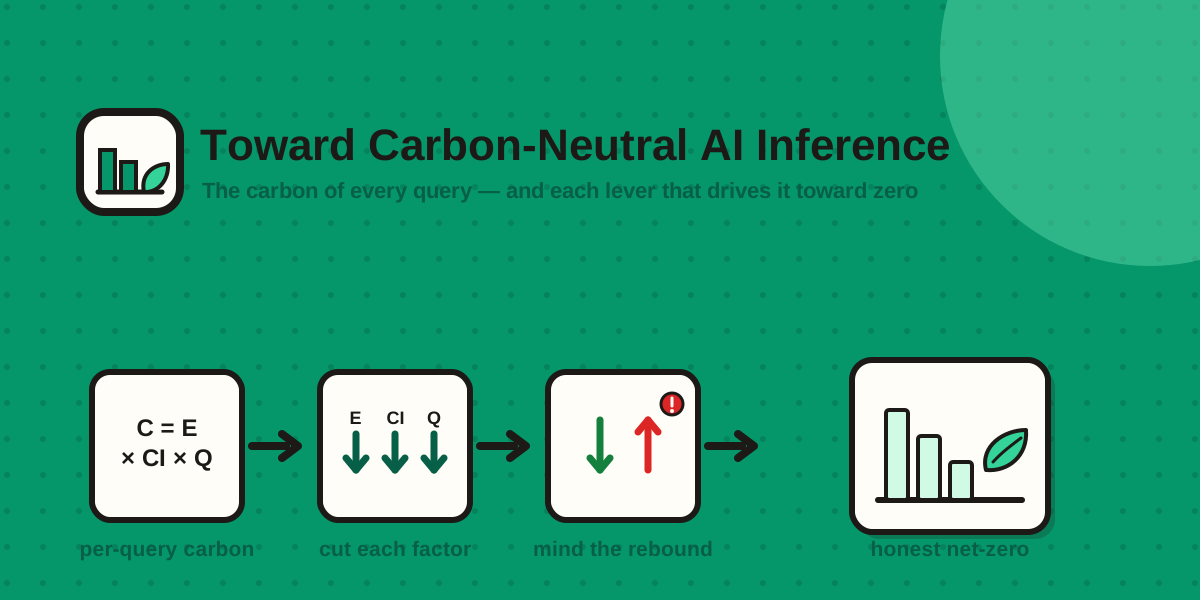
AI inference has become a large, fast-growing source of electricity demand and carbon emissions — and unlike one-time training, it recurs on every query and scales with adoption, so AI's footprint is increasingly dominated by serving. Measurement now exists, but it does not tell us how to reach carbon neutrality or what "neutral" should honestly mean. This review organizes the problem around a single identity — per-query carbon = per-query energy × grid carbon intensity, scaled by query volume — and classifies the pathways to net-zero by the factor each one attacks, defines carbon-neutral inference as a credible residual-offset condition, and maps the accuracy, latency, and rebound costs of getting there.
This review treats the carbon neutrality of AI as primarily an inference problem: unlike a one-time training run, inference recurs on every query and scales with adoption. It organizes the field around a single identity — per-query carbon equals per-query energy times grid carbon intensity, scaled by query volume — and uses it to classify mitigation pathways by the factor each attacks: model right-sizing and efficiency; carbon-aware temporal and spatial scheduling; renewable-matched and edge inference; and demand shaping through caching, batching, and query budgeting. For each pathway it summarizes the mechanism, the reported magnitude of savings, and the limits and risks, including the accuracy, latency, and freshness costs that make every lever a tradeoff rather than a free win. It then defines carbon-neutral inference as a residual-offset condition, argues for a credibility bar on offsets, and confronts the rebound (Jevons) effect by which per-query efficiency gains can raise total emissions. It closes with an agenda for standardized, auditable, net-zero AI serving. It synthesizes and cites the lab's own carbon and water measurement work rather than reporting new experiments. Invited feature paper; faculty-advised.